Category Archives: Density Functional Theory

First-Principles Simulation of Ionizing Radiation Damage in Molecular Systems over Short Time Scales

Naija Pison, Aurelio Alvarez-Ibarra, Roberto Flores-Moreno, Dominique Guillaumont, Aurélien de la Lande, J. Chem. Theor. Comput. 2026 DOI: doi.org/10.1021/acs.jctc.6c01190

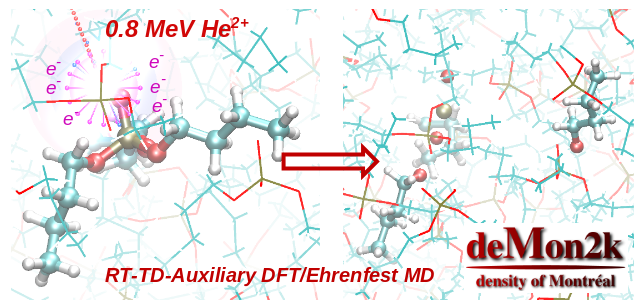
In this work, we present an ab initio molecular simulation method designed to investigate the ultrashort timescales of radiation chemistry induced by ionizing radiation, in particular fast ions and electric pulses. The approach accounts for energy deposition at the sub-femtosecond scale, electron emission, and energy dissipation into nuclear vibrational modes, which may ultimately lead to the formation of the earliest radiation-induced damages. The method, implemented in deMon2k, is based on the coupling between Real-Time Time-Dependent Density Functional Theory (RT-TDDFT) within the Auxiliary Density Functional Theory formalism and Ehrenfest mean-field dynamics. A hybrid QM/MM scheme further enables the simulation of radiation damage formation in complex and heterogeneous systems such as proteins or DNA. The method has been tested on a set of benchmark molecules and achieves controlled numerical accuracy down to the micromicroeV scale for the total energy conservation. From a computational efficiency perspective, the implementation relies on the Auxiliary DFT formalism and fully benefits from modern CPU- and GPU-based computer architectures. As an illustrative application, we present simulations of a solvated tributyl phosphate molecule subjected to alpha radiation, a problem of direct relevance to the nuclear industry. The study analyzes the energy deposition mechanisms, the dissipation pathways, and the characterization of the earliest radiation-induced damages. In summary, the ionizing-radiation chemistry module of deMon2k presented here opens the way toward a deeper understanding of the ultrafast formation of radiation-induced chemical damages in fields as diverse as biology, the nuclear industry, aerospace science, and astrochemistry.
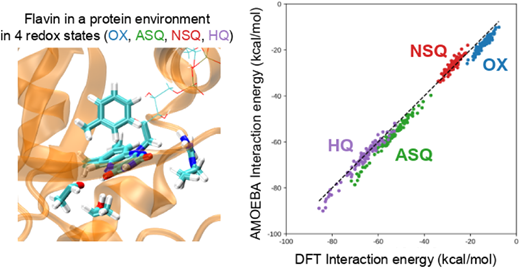
AMOEBA Polarizable Atomic Multipole Force Field Parameters for Flavins

Mélody Aeck, Aurélien de la Lande, Carine Clavaguéra, Fabien Cailliez. J. Chem. Theory Comput. 2026 22, 8954–8965. DOI: https://doi.org/10.1021/acs.jctc.6c00958.

Computation of redox potential of cofactors in biological systems requires an accurate description of the interaction between the redox cofactors and the biomolecular environment and extensive conformational sampling. Seeking to achieve a quantitative leap in redox potential evaluation for flavoproteins, we report here the calibration of sets of parameters to describe flavin molecules in various redox states in the framework of AMOEBA, a multipolar and polarizable force field. We calibrate both the isoalloxazine ring in the five biologically relevant redox states and the polyol chain needed to describe riboflavin or flavin adenine dinucleotide molecules. We propose a delineated, step-by-step protocol to accurately account for the physical effects at play. We provide evidence that these parameters produce stable conformations in agreement with quantum chemistry (DFT) calculations. The newly derived AMOEBA force field allows to compute interaction energies of lumiflavin with water molecules and amino acids in very good agreement with quantum chemistry calculations, with a net improvement with respect to a monopolar nonpolarizable force field. Finally, as a first application, we compute redox free energy of half-reactions for two redox couples of lumiflavin in water. The values obtained are once again in better agreement with DFT values than those obtained with a standard classical force field.

Electron dynamics simulation of photoionization of N2 using Gaussian basis sets optimized for the continuum

Roberta Leonetti, Federica Agostini, Aurélien de la Lande, J. Chem. Phys. 165, 094119 (2026).

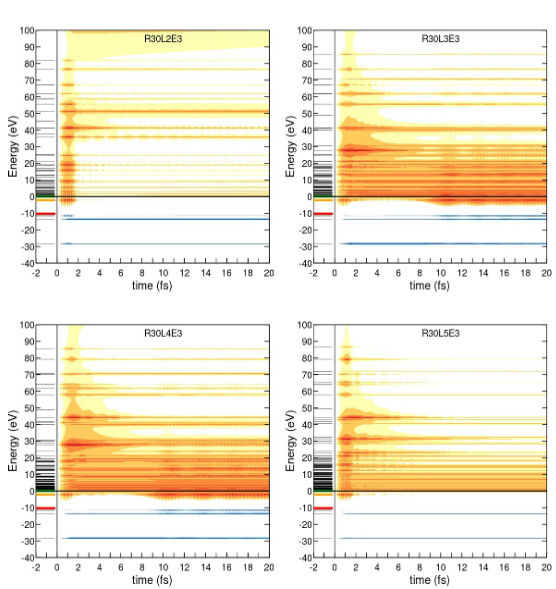
We explore the capability of real-time time-dependent auxiliary density functional theory (RT-TD-ADFT) to capture photoionization of the nitrogen molecule when employed in combination with atomic Gaussian basis sets optimized for the continuum (AOC). The molecule is ionized by an ultrashort laser pulse in the near- and far off-resonant energy conditions. The dependence of the calculated amount of deposited energy and of emitted electrons on various sets of AOC is investigated. We find that for energies below a threshold of ∼25 eV, the simulations carried out with sufficiently angularly flexible AOC capture reasonably well the physics of the photoionization process, while AOC do not seem adequate to describe photoionization occurring at higher energies. We also find that accounting for exact exchange in the simulation moderately affects the results in the near-resonant situation, while it has a stronger impact on the appearance of the so-called molecular dipole instability a few fs after ionization in the far off-resonant case. Overall, this work paves the way for the evaluation of photoelectron spectra based on RT-TD-ADFT.

Computational Study of Heme b595 to Heme d Electron Transfer in E. coli Cytochrome bd-I Oxidase

Raaif Siddeeque, Baptiste Etcheverry, Côme Cattin, Jean Deviers, Frédéric Melin, Petra Hellwig, Fabien Cailliez, Aurélien de la Lande. J. Chem. Inform. Mod. 2026, 66, 1757. DOI: doi.org/10.1021/acs.jcim.5c02194. Link to Biorxiv

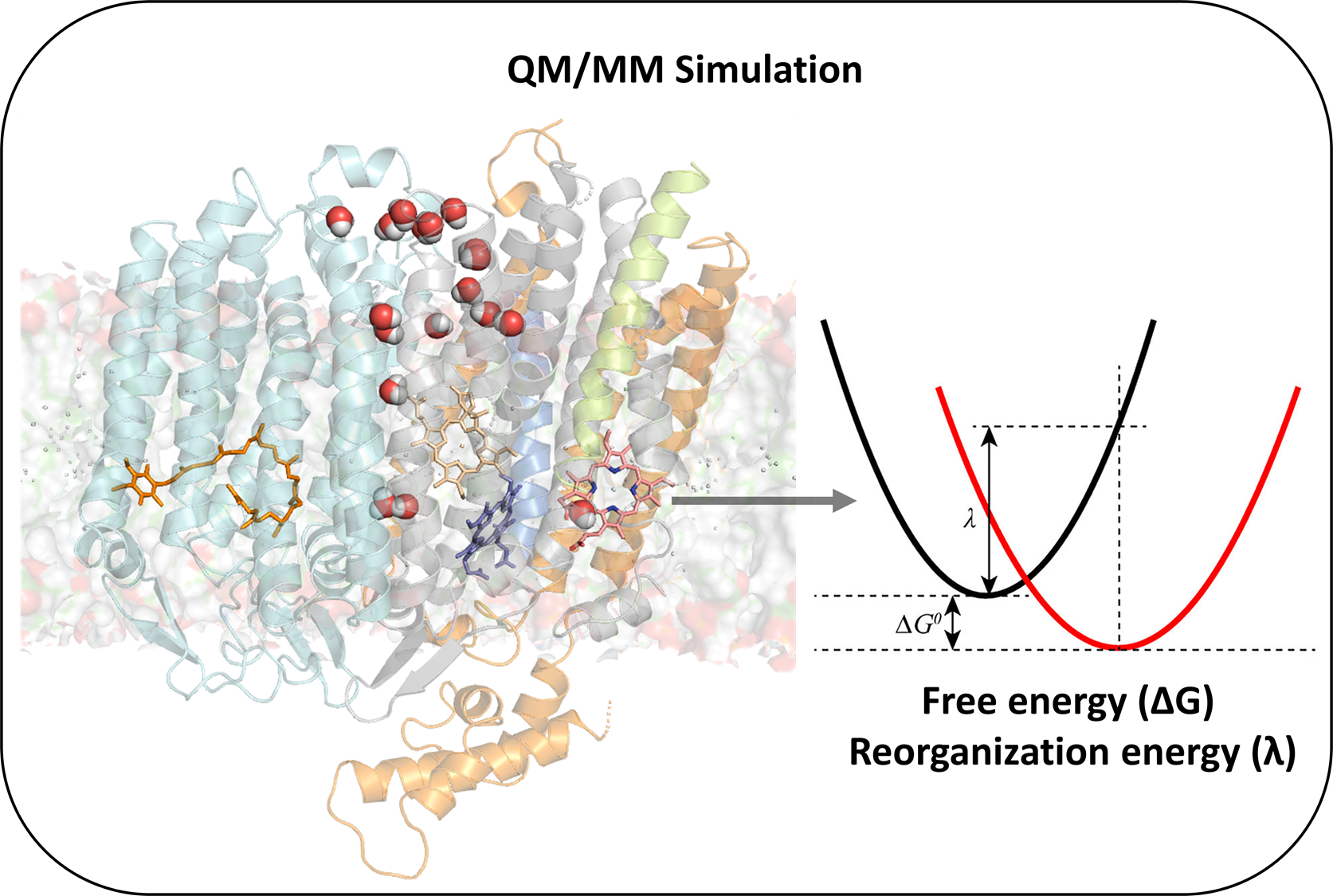
Cytochrome bd is a distinctive family of terminal oxidases present in the respiratory chains of many prokaryotes. Despite their biological importance, the redox chemistry of these proteins remains poorly understood, largely due to the presence of two b-type hemes and one d-type heme. Here, we report the first computational study of interheme electron transfer in the cytochrome bd family. We performed 10 μs of molecular dynamics simulations of E. coli cytochrome bd-I embedded in realistic membranes, combined with quantum chemical calculations to estimate the thermodynamic parameters of electron transfer from heme b595 to heme d within the framework of Marcus theory. We further identify the respective contributions of the hemes, protein scaffold, lipid bilayer, water, and counterions to the driving force and reorganization energy. The interheme electronic coupling was calculated using the Projected Orbital Diabatization (POD) method in a hybrid Quantum Mechanics/Molecular Mechanics scheme and rationalized through electron transfer pathway analysis. This study provides fundamental insights into how electron transfer steps are orchestrated in the catalytic cycle of E. coli cytochrome bd-I.

Coordination of Deprotonated Ferrous Heme with CO and O2 in the Gas Phase: Influence of Spin-Orbit Splitting and Charge

A Muhieddine, S Soorkia, J Attard, A de La Lande, Niloufar Shafizadeh, B Soep. J. Phys. Chem. A, 2025, 129, 7087–7093. DOI: doi.org/10.1021/acs.jpca.5c02554

The ligation of 4-coordinated ferrous heme has been investigated in the gas phase using singly deprotonated heme anions to act as a model for neutral heme. The equilibrium of dioxygen and carbon monoxide ligated to deprotonated heme was observed in the 250–150 K temperature range in a Paul ion trap. The van’t Hoff equation was used for the determination of ligand binding energies with CO or O2. Density functional theory calculations have been undertaken to analyze the mechanism of bonding that evolves through spin-orbit crossing between the triplet heme reactant and the singlet carbon monoxide-ligated product. The deprotonated heme anion is a good model for neutral heme, since the negative charge on the carboxylate end of the propionate group of heme is shown to have little influence. Deprotonated heme anions yield a ligation enthalpy of 4-coordinated heme with O2 or CO, which is surprisingly low (respectively, ΔH = 20.6 ± 1.7 and 37.9 ± 1.6 kJ mol1).

Avian cryptochrome 4 binds superoxide

Jean Deviers, Fabien Cailliez, Aurélien de la Lande, Daniel R Kattnig, Comput. Struct. Biol. J. 2024, 26, 11-21. https://doi.org/10.1016/j.csbj.2023.12.009 (open access).

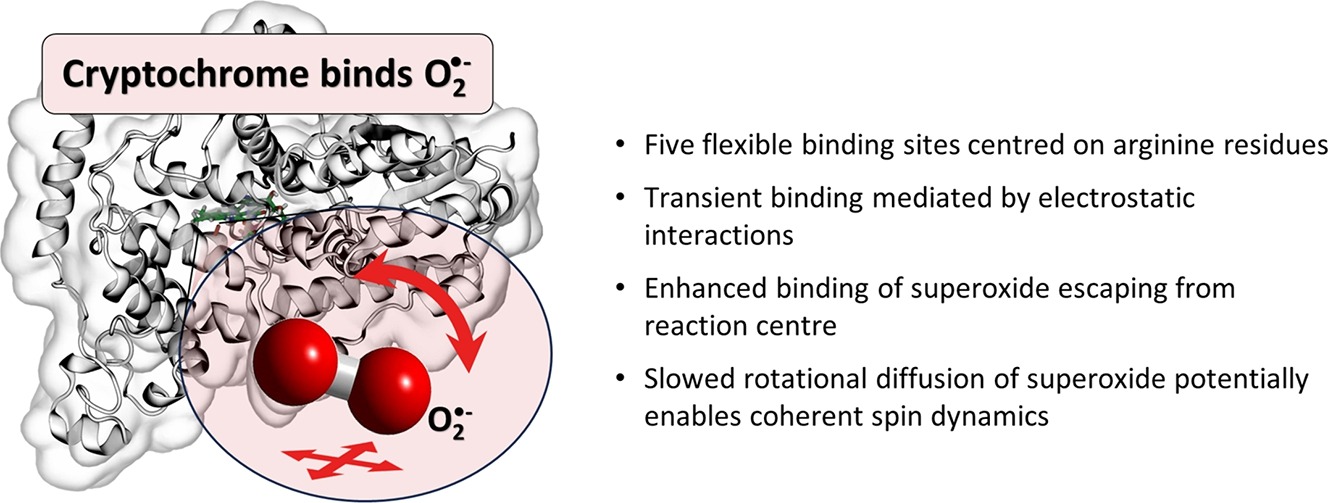
Flavin-binding cryptochromes are blue-light sensitive photoreceptors that have been implicated with magnetoreception in some species. The photocycle involves an intra-protein photo-reduction of the flavin cofactor, generating a magnetosensitive radical pair, and its subsequent re-oxidation. Superoxide (O) is generated in the re-oxidation with molecular oxygen. The resulting O-containing radical pairs have also been hypothesised to underpin various magnetosensitive traits, but due to fast spin relaxation when tumbling in solution would require immobilisation. We here describe our insights in the binding of superoxide to cryptochrome 4 from C. livia based on extensive all-atom molecular dynamics studies and density-functional theory calculations. The positively charged “crypt” region that leads to the flavin binding pocket transiently binds O at 5 flexible binding sites centred on arginine residues. Typical binding times amounted to tens of nanoseconds, but exceptional binding events extended to several hundreds of nanoseconds and slowed the rotational diffusion, thereby realising rotational correlation times as large as 1 ns. The binding sites are particularly efficient in scavenging superoxide escaping from a putative generation site close to the flavin-cofactor, possibly implying a functional relevance. We discuss our findings in view of a potential magnetosensitivity of biological flavin semiquinone/superoxide radical pairs.

Chlorophyll and pheophytin protonated and deprotonated ions: Observation and theory

M Diop, M El-Hayek, J Attard, A Muhieddine, V Veremeienko, S Soorkia, Ph Carbonnière, A de la Lande, B Soep, N Shafizadeh. J. Chem. Phys. 2023, 159, 194308. https://doi.org/10.1063/5.0174351. Link for full text in HAL.

Reproduced with permission from the publisher.

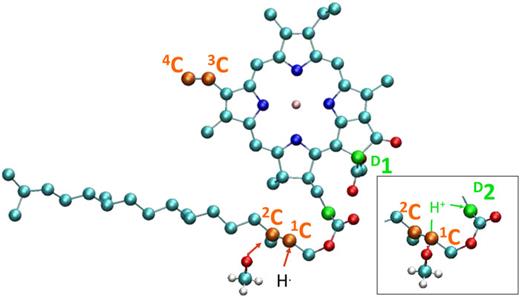
Pheophytin a and chlorophyll a have been investigated by electrospray mass spectrometry in the positive and negative modes, in view of the importance of the knowledge of their properties in photosynthesis. Pheophytin and chlorophyll are both observed intensely in the protonated mode, and their main fragmentation route is the loss of their phytyl chain. Pheophytin is observed intact in the negative mode, while under collisions, it is primarily cleaved beyond the phytyl chain and loses the attaching propionate group. Chlorophyll is not detected in normal conditions in the negative mode, but addition of methanol solvent molecule is detected. Fragmentation of this adduct primarily forms a product (−30 amu) that dissociates into dephytyllated deprotonated chlorophyll. Semi-empirical molecular dynamics calculations show that the phytyl chain is unfolded from the chlorin cycle in pheophytin a and folded in chlorophyll a. Density functional theory calculations have been conducted to locate the charges on protonated and deprotonated pheophytin a and chlorophyll a and have found the major location sites that are notably more stable in energy by more than 0.5 eV than the others. The deprotonation site is found identical for pheophytin a and the chlorophyll a-methanol adduct. This is in line with experiment and calculation locating the addition of methanol on a double bond of deprotonated chlorophyll a.

Use of Gaussian-Type Functions for Describing Fast Ion-Matter Irradiation with Time-Dependent Density Functional Theory

Rika Tandiana, Karwan Ali Omar, Eleonora Luppi, Fabien Cailliez, Nguyen-Thi Van-Oanh, Carine Clavaguéra, Aurélien de la Lande. J. Chem. Theor. Comput. 2023, 19, 21, 7740–7752. doi.org/10.1021/acs.jctc.3c00656. Link for full text in HAL.

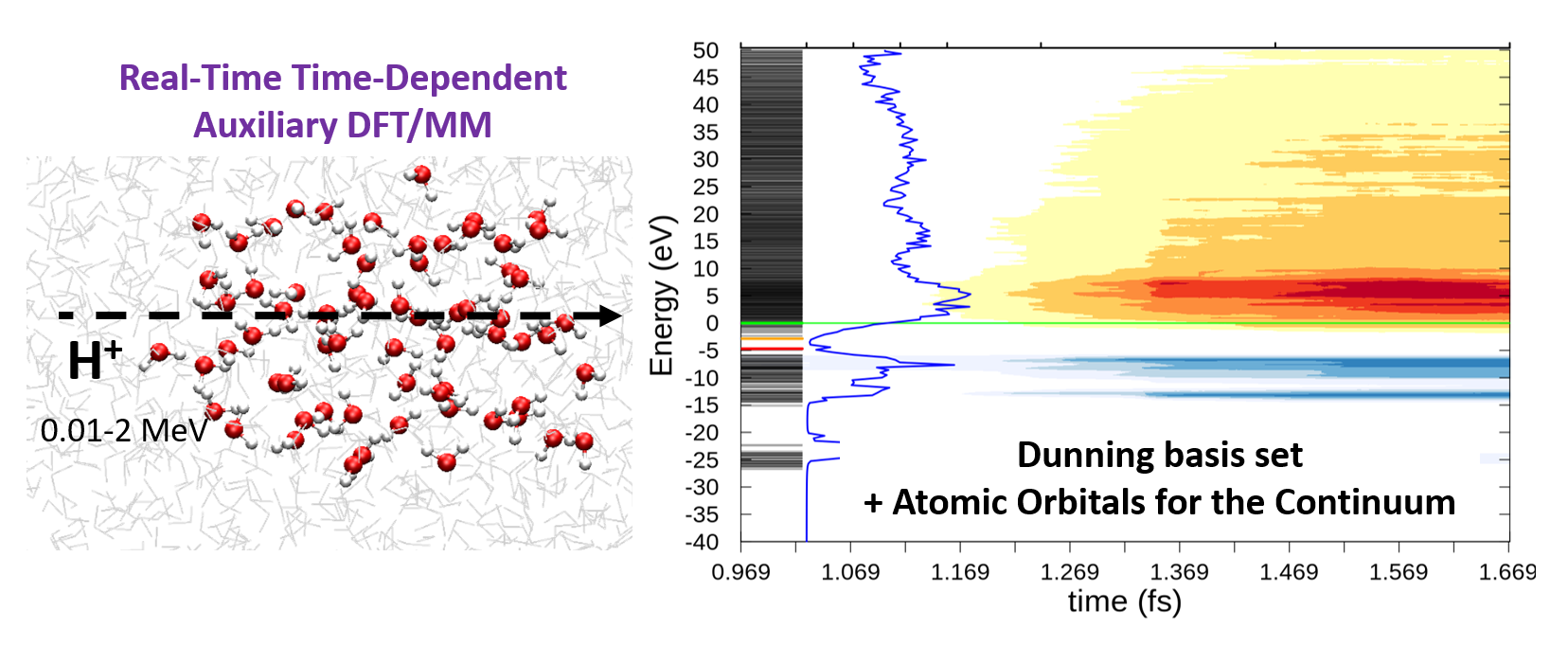
The electronic stopping power is an observable property that quantifies the ability of swift ions to penetrate matter to transfer energy to the electron cloud. The recent literature has proven the value of Real-Time Time-Dependent Density Functional Theory to accurately evaluate this property from first-principles, but questions remain regarding the capability of computer codes relying on atom-centered basis functions to capture the physics at play. In this Perspective, we draw attention to the fact that irradiation by swift ions triggers electron emission into the continuum, especially at the Bragg peak. We investigate the ability of Gaussian atomic orbitals (AOC), which were fitted to mimic continuum wave functions, to improve electronic stopping power predictions. AOC are added to standard correlation-consistent basis sets or STO minimal basis sets. Our benchmarks for water irradiation by fast protons clearly advocate for the use of AOC, especially near the Bragg peak. We show that AOC only need to be placed on the molecules struck by the ion. The number of AOC that are added to the usual basis set is relatively small compared to the total number of atomic orbitals, making the use of such a basis set an excellent choice from a computational cost point of view. The optimum basis set combination is applied for the calculation of the stopping power of a proton in water with encouraging agreement with experimental data.

Irradiation of Plutonium Tributyl Phosphate Complexes by Ionizing Alpha Particles: A Computational Study

Damien Tolu, Dominique Guillaumont, Aurélien de la Lande. J. Phys. Chem. A. 2023, 127, 34, 7045–7057. doi.org/10.1021/acs.jpca.3c02117. Link to full text in HAL.

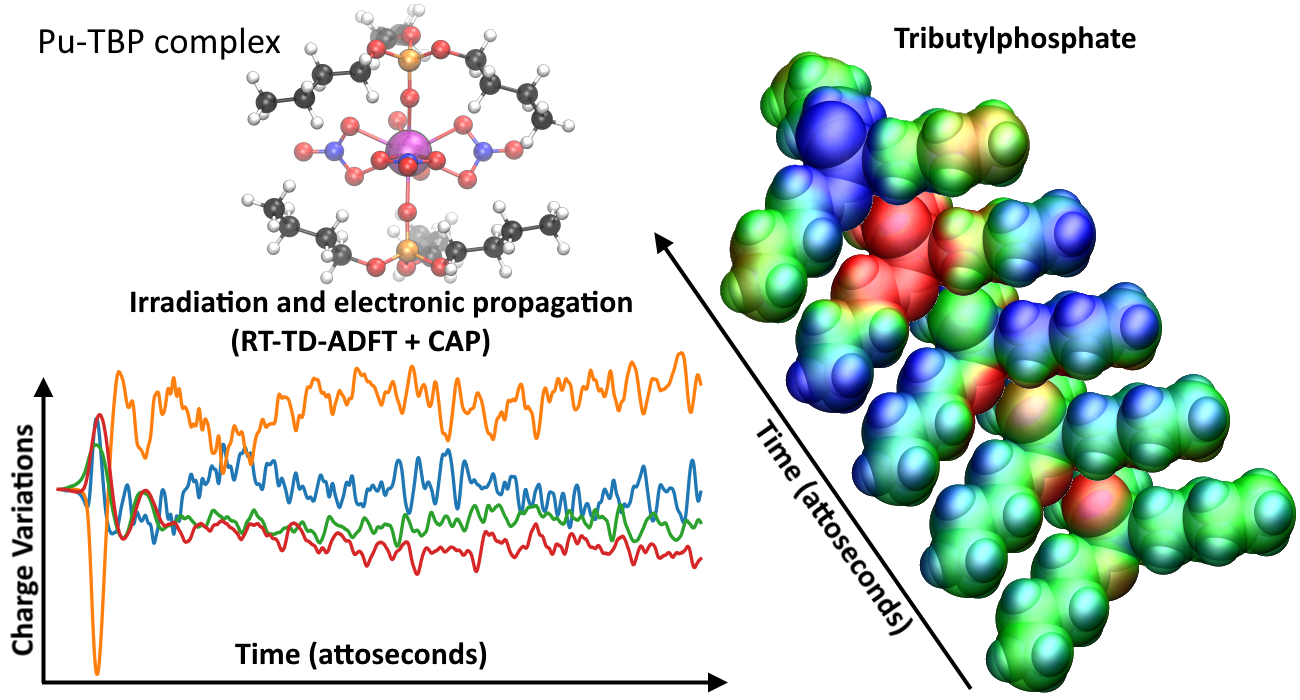
The PUREX solvent extraction process, widely used for recovering uranium and plutonium from spent nuclear fuel, utilizes an organic solvent composed of tributyl phosphate (TBP). The emission of ionizing particles such as alpha particles, resulting from the decay of plutonium, makes the organic solvent vulnerable to degradation. Here, we study the ultrashort time alpha irradiation of tributylphosphate (TBP) and Pu(NO3)4(TBP)2 complex formed in the PUREX process. Electron dynamics is propagated by Real-Time-Dependent Auxiliary Density Functional Theory (RT-TD-ADFT). We investigate the use of previously proposed absorption boundary conditions (ABC) in the molecular orbital space to treat secondary electron emission. Basis set and exchange correlation functional effects with ABC are reported as well as a detailed analysis of the ABC parametrization. Preliminary results on the water molecule and then on TBP show that the phenomenological nature of the ABC parameters necessitates selecting appropriate values for each system under study. Irradiation of free and complexed TBP shows an influence of the ligands on the variation of atomic charges on the femtosecond time scale. An accumulation of atomic charges in the alkyl chains of TBP is observed in the case where the nitrate groups are predominantly irradiated. In addition, we find that the Pu atom regains its electric charge very rapidly after being hit by the projectile, with the coordination sphere serving as an electron reservoir to preserve its formal redox state. This study paves the road toward a full understanding of the degradation of organic extracants employed in the nuclear industry.

Current status of deMon2k for the investigation of the early stages of matter irradiation by time-dependent DFT approaches

Karwan A Omar, Feven A Korsaye, Rika Tandiana, Damien Tolu, Jean Deviers, Xiaojing Wu, Angela Parise, Aurelio Alvarez-Ibarra, Felix Moncada, Jesus Nain Pedroza-Montero, Daniel Mejía-Rodriguez, Nguyen-Thi Van-Oanh, Fabien Cailliez, Carine Clavaguéra, Karim Hasnaoui, Aurélien de la Lande. Eur. J. Special Topics, 2023. doi.org/10.1140/epjs/s11734-023-00905-6. Full text in HAL.

Special collection: Ultrafast Phenomena from attosecond to picosecond timescales: theory and experiments

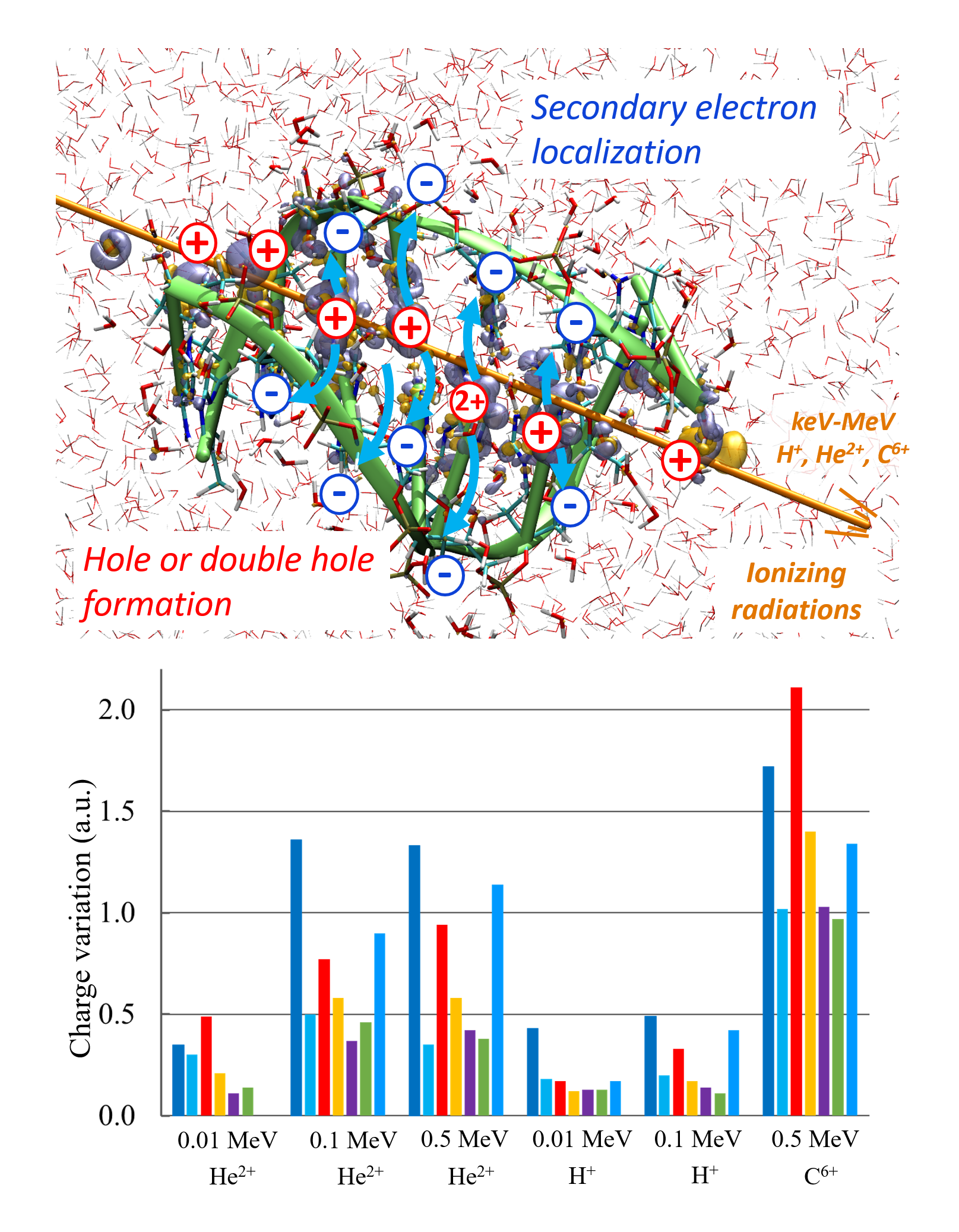
We summarize in this article the recent progress made in our laboratories in the development of numerical approaches dedicated to investigating ultrafast physicochemical responses of biological matter subjected to ionizing radiations. Our modules are integrated into the deMon2k software which is a readily available program with highly optimized algorithms for conducting Auxiliary Density Functional Theory (ADFT) calculations. We have developed a computational framework based on Real-Time Time-dependent ADFT to simulate the electronic responses of molecular systems to strong perturbations, while molecular dynamics simulations in the ground and excited states (Ehrenfest dynamics) are available to simulate irradiation-induced ultrafast bond breaking/formation. Constrained ADFT and Multi-component ADFT have also been incorporated to simulate charge transfer processes and nuclear quantum effects, respectively. Finally, a coupling to polarizable force fields further permits to realistically account for the electrostatic effects that the systems’ environment has on the perturbed electron density. The code runs on CPU or hybrid CPU/GPU architectures affording simulations of systems comprised up to 1000 atoms at the DFT level with controlled numerical accuracy. We illustrate the applications of these methodologies by taking results from our recent articles that aimed principally at understanding experimental data from pulse radiolysis experiments.