Category Archives: hemes and chlorophylls

Coordination of Deprotonated Ferrous Heme with CO and O2 in the Gas Phase: Influence of Spin-Orbit Splitting and Charge

A Muhieddine, S Soorkia, J Attard, A de La Lande, Niloufar Shafizadeh, B Soep. J. Phys. Chem. A, 2025, 129, 7087–7093. DOI: doi.org/10.1021/acs.jpca.5c02554

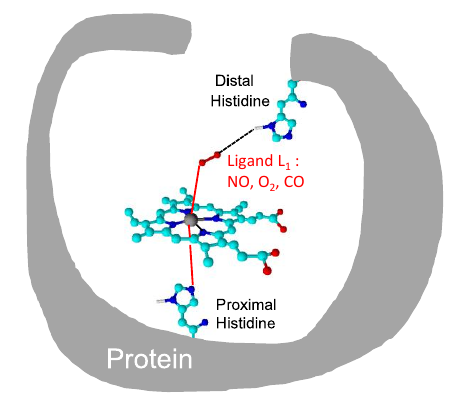
The ligation of 4-coordinated ferrous heme has been investigated in the gas phase using singly deprotonated heme anions to act as a model for neutral heme. The equilibrium of dioxygen and carbon monoxide ligated to deprotonated heme was observed in the 250–150 K temperature range in a Paul ion trap. The van’t Hoff equation was used for the determination of ligand binding energies with CO or O2. Density functional theory calculations have been undertaken to analyze the mechanism of bonding that evolves through spin-orbit crossing between the triplet heme reactant and the singlet carbon monoxide-ligated product. The deprotonated heme anion is a good model for neutral heme, since the negative charge on the carboxylate end of the propionate group of heme is shown to have little influence. Deprotonated heme anions yield a ligation enthalpy of 4-coordinated heme with O2 or CO, which is surprisingly low (respectively, ΔH = 20.6 ± 1.7 and 37.9 ± 1.6 kJ mol1).
Chlorophyll and pheophytin protonated and deprotonated ions: Observation and theory

M Diop, M El-Hayek, J Attard, A Muhieddine, V Veremeienko, S Soorkia, Ph Carbonnière, A de la Lande, B Soep, N Shafizadeh. J. Chem. Phys. 2023, 159, 194308. https://doi.org/10.1063/5.0174351. Link for full text in HAL.

Reproduced with permission from the publisher.

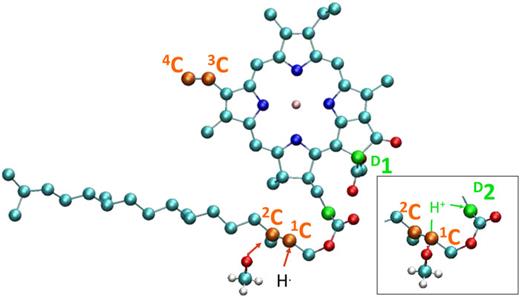
Pheophytin a and chlorophyll a have been investigated by electrospray mass spectrometry in the positive and negative modes, in view of the importance of the knowledge of their properties in photosynthesis. Pheophytin and chlorophyll are both observed intensely in the protonated mode, and their main fragmentation route is the loss of their phytyl chain. Pheophytin is observed intact in the negative mode, while under collisions, it is primarily cleaved beyond the phytyl chain and loses the attaching propionate group. Chlorophyll is not detected in normal conditions in the negative mode, but addition of methanol solvent molecule is detected. Fragmentation of this adduct primarily forms a product (−30 amu) that dissociates into dephytyllated deprotonated chlorophyll. Semi-empirical molecular dynamics calculations show that the phytyl chain is unfolded from the chlorin cycle in pheophytin a and folded in chlorophyll a. Density functional theory calculations have been conducted to locate the charges on protonated and deprotonated pheophytin a and chlorophyll a and have found the major location sites that are notably more stable in energy by more than 0.5 eV than the others. The deprotonation site is found identical for pheophytin a and the chlorophyll a-methanol adduct. This is in line with experiment and calculation locating the addition of methanol on a double bond of deprotonated chlorophyll a.

Insights into the effect of distal histidine and water hydrogen bonding on NO ligation to ferrous and ferric heme: a DFT study

Fatemeh Fateminasab, Aurelien de La Lande, Reza Omidyan. RSC Advances, 2022, 12, 4703-4713. doi.org/10.1039/D1RA08398H.

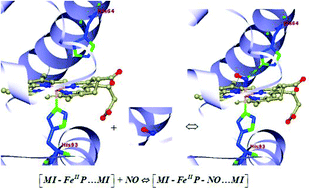
The effect of distal histidine on ligation of NO to ferrous and ferric-heme, has been investigated with the high-level density functional theoretical (DFT) method. It has been predicted that the distal histidine significantly stabilizes the interaction of NO ferrous-heme (by −2.70 kcal mol−1). Also, water hydrogen bonding is quite effective in strengthening the Fe–NO bond in ferrous heme. In contrast in ferric heme, due to the large distance between the H2O and O(NO) and lack of hydrogen bonding, the distal histidine exhibits only a slight effect on the binding of NO to the ferric analogue. Concerning the bond nature of FeII–NO and FeIII–NO in heme, a QTAIM analysis predicts a partially covalent and ionic bond nature in both systems.

Theoretical insights on the effect of environments on binding of CO to the Heme: Ferrous and Ferric systems

Fatemeh Fateminasab, Mohammad Aarabi, Aurelien de La Lande, Reza Omidyan. J. Mol. Liquids. 2021, 344, 117961. doi.org/10.1016/j.molliq.2021.117961.

In the present study, we have employed a high-level density functional theory (DFT) model to investigate both implicit and explicit effects of solvation (i.e., the bulk solvation effect as well as microhydration) in addition to the effect of distal Histidine on the binding of CO to Ferrous and Ferric-Heme. It has been predicted that the distal N-methylimidazole (MI) in addition to microsolvation, as a simple mode of environment, leads to a significant stabilization on the binding of CO to Heme-FeII (by ∼ 4 kcal mol−1). This is while no clear alteration has been predicted for the implicit solvation model. For the Ferric heme, and in contrast to the Ferrous system, strong destabilization from the environment has been predicted for binding CO to the Ferric heme analog.

Heme ligation in the gas phase

N. Shafizadeh, M.E. Crestoni, A. de la Lande, B Soep. Intern. Rev. Phys. Chem. 2021, 40, 365-404 . doi.org/10.1080/0144235X.2021.1952006. Link to of full text in HAL.

This review summarizes the state-of-the-art knowledge of heme ligation in the gas phase. The unique aspect of the gas phase approach is to allow a step-by-step ligation of heme and thus enables the analysis of the properties of -four, -five and -six coordinate hemes in vacuo, under conditions directly comparable with quantum calculations. This approach also allows the characterization of situations uncommon in Nature, completing the coordination spectrum of hemes: four coordinate heme and protonated heme, an intermediate between ferrous and ferric heme. Therefore, a complete set of systems is described for the ferrous and ferric cases and there is no discontinuity between the two oxidation states of iron, so that the same mechanisms are at work, donation and back donation of different strengths depending upon the ligand. The similarity of ligation properties in ferrous and ferric hemes is consistent with calculations of the electron density at the Fe atom level, rather independent of the formal oxidation state in contrast with the porphyrin cycle. Hemes spin states have been reviewed, for they identify the electronic distribution of the metal. In ligated ferrous and ferric hemes, we find that binding energy measurements combined with spectroscopy describe their properties most effectively.