Category Archives: Density Functional Theory

Following the density evolution using real time density functional theory and density based indexes: Application to model push–pull molecules

Feven Alemu Korsaye, Aurélien de la Lande, Ilaria Ciofini. J. Comput. Chem. 2023, 43, 1464. doi.org/10.1002/jcc.26932. Full text in HAL

Considering as test case a family of organic rod like push–pull molecules, we derived and applied density based index enabling the description and diagnostic of the electronic density evolution in real time-time dependent density functional theory (RT-TDDFT) simulations. In particular, both the charge transfer (CT) distance and a diagnostic index, the DCT and MACRT respectively, were computed on the fly from the density distribution obtained at a given time and the reference ground state density and their mean values were compared with what obtained at Linear Response-TDDFT level. Besides giving a way of analyzing the density redistribution occurring in time, these tools allowed to show how RT-TDDFT, which is definitely a powerful method to model the evolution of the density in CT or charge separation processes, can be affected by the same artifacts known for LR-TDDFT approaches and, particularly, to those related to the use of approximate exchange correlation functionals. The analysis here performed allowed to identify and discard on fly the electronic configurations corresponding to spurious situations.
Ab initio derivation of flavin hyperfine interactions for the protein magnetosensor cryptochrome

Jean Deviers, Fabien Cailliez, Bernardo Zúñiga Gutiérrez, Daniel R Kattnig, Aurélien de la Lande. Phys. Chem. Chem. Phys. 2022. 24, 16784-16798. doi.org/10.1039/D1CP05804E. Full text in HAL.

The radicals derived from flavin adenine dinucleotide (FAD) are a corner stone of recent hypotheses about magnetoreception, including the compass of migratory songbirds. These models attribute a magnetic sense to coherent spin dynamics in radical pairs within the flavo-protein cryptochrome. The primary determinant of sensitivity and directionality of this process are the hyperfine interactions of the involved radicals. Here, we present a comprehensive computational study of the hyperfine couplings in the protonated and unprotonated FAD radicals in cryptochrome 4 from C. livia. We combine long (800 ns) molecular dynamics trajectories to accurate quantum chemistry calculations. Hyperfine parameters are derived using auxiliary density functional theory applied to cluster and hybrid QM/MM (Quantum Mechanics/Molecular Mechanics) models comprising the FAD and its significant surrounding environment, as determined by a detailed sensitivity analysis. Thanks to this protocol we elucidate the sensitivity of the hyperfine interaction parameters to structural fluctuations and the polarisation effect of the protein environment. We find that the ensemble-averaged hyperfine interactions are predominantly governed by thermally induced geometric distortions of the flavin. We discuss our results in view of the expected performance of these radicals as part of a magnetoreceptor. Our data could be used to parametrize spin Hamiltonians including not only average values but also standard deviations.

Insights into the effect of distal histidine and water hydrogen bonding on NO ligation to ferrous and ferric heme: a DFT study

Fatemeh Fateminasab, Aurelien de La Lande, Reza Omidyan. RSC Advances, 2022, 12, 4703-4713. doi.org/10.1039/D1RA08398H.

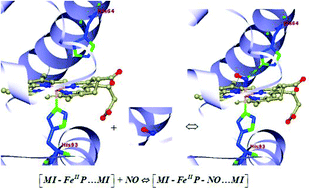
The effect of distal histidine on ligation of NO to ferrous and ferric-heme, has been investigated with the high-level density functional theoretical (DFT) method. It has been predicted that the distal histidine significantly stabilizes the interaction of NO ferrous-heme (by −2.70 kcal mol−1). Also, water hydrogen bonding is quite effective in strengthening the Fe–NO bond in ferrous heme. In contrast in ferric heme, due to the large distance between the H2O and O(NO) and lack of hydrogen bonding, the distal histidine exhibits only a slight effect on the binding of NO to the ferric analogue. Concerning the bond nature of FeII–NO and FeIII–NO in heme, a QTAIM analysis predicts a partially covalent and ionic bond nature in both systems.

Theoretical insights on the effect of environments on binding of CO to the Heme: Ferrous and Ferric systems

Fatemeh Fateminasab, Mohammad Aarabi, Aurelien de La Lande, Reza Omidyan. J. Mol. Liquids. 2021, 344, 117961. doi.org/10.1016/j.molliq.2021.117961.

In the present study, we have employed a high-level density functional theory (DFT) model to investigate both implicit and explicit effects of solvation (i.e., the bulk solvation effect as well as microhydration) in addition to the effect of distal Histidine on the binding of CO to Ferrous and Ferric-Heme. It has been predicted that the distal N-methylimidazole (MI) in addition to microsolvation, as a simple mode of environment, leads to a significant stabilization on the binding of CO to Heme-FeII (by ∼ 4 kcal mol−1). This is while no clear alteration has been predicted for the implicit solvation model. For the Ferric heme, and in contrast to the Ferrous system, strong destabilization from the environment has been predicted for binding CO to the Ferric heme analog.

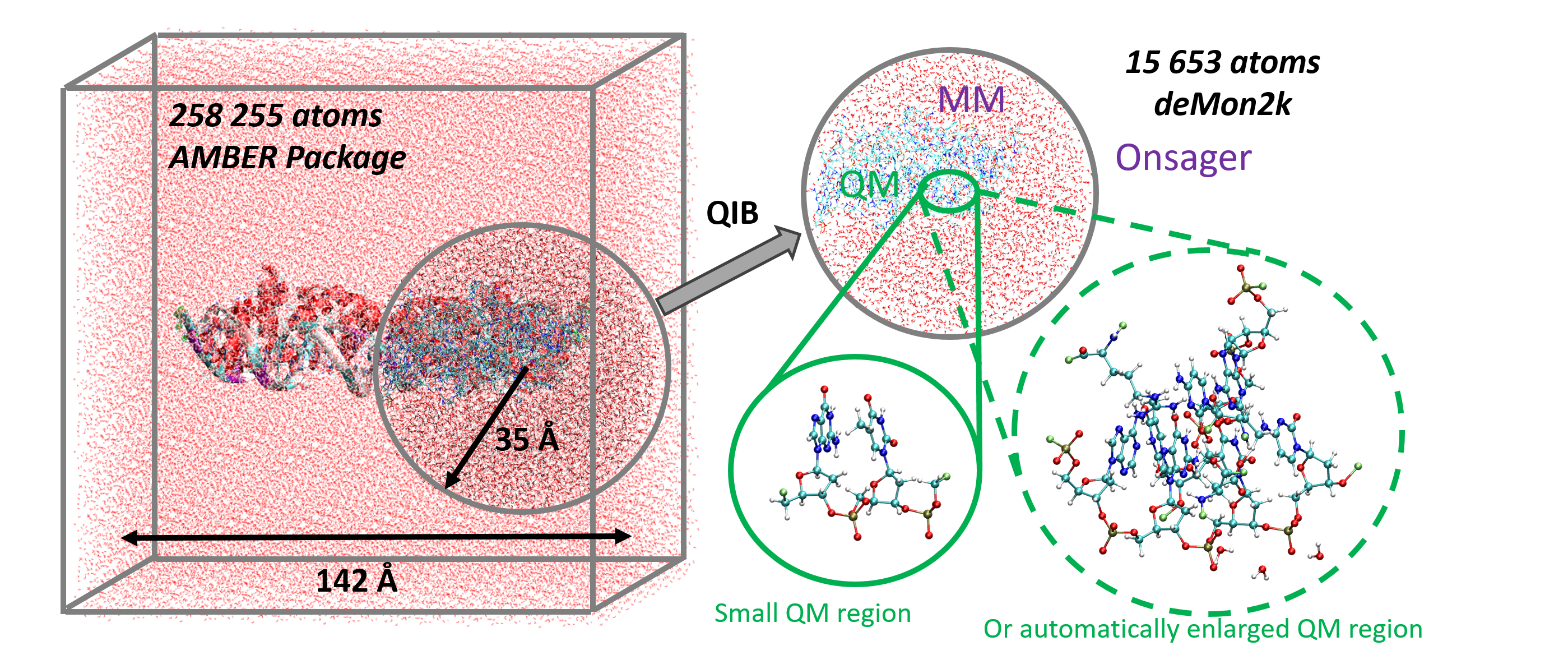
QM/MM with Auxiliary DFT in deMon2k

J. D Samaniego-Rojas, L. I. Hernández-Segura, L. López-Sosa, R. I Delgado-Venegas, B. Gomez, J.-C. Lambry, A. de la Lande, T. Mineva, J. Alejandre, B. A Zúñiga-Gutiérrez, R. Flores-Moreno, P. Calaminici, G. Geudtner, A. M Köster.Andreas in Multiscale Dynamics Simulations: Nano and Nano-bio Systems in Complex Environments.Edited by D. Wei and D. R. Salahub. 2021. Royal Chemical Society. doi.org/10.1039/9781839164668-00001

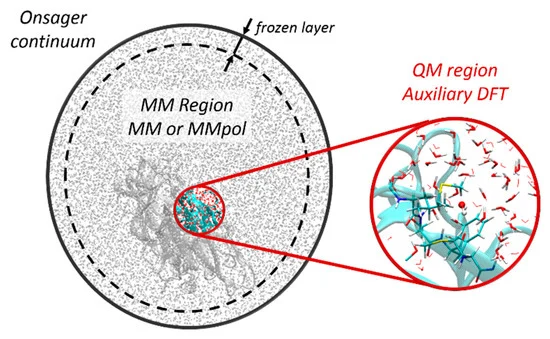
This chapter describes the theoretical background of the quantum mechanical/molecular mechanical (QM/MM) implementation in deMon2k within the framework of auxiliary density functional theory (ADFT). It aims to give the reader an overview of the current state of the art of this QM/MM implementation and perspectives for its future development. To this end, we first derive the ADFT working equations for the QM and QM/MM energy and gradient expressions. Based on the joint QM/MM gradient expression, we present algorithms for QM/MM structure optimizations, transition-state searches and molecular dynamics simulations. The use of auxiliary density perturbation theory (ADPT) in the framework of QM/MM is discussed using illustrative implementations including analytic second-order ADFT energy derivatives, nuclear magnetic resonance chemical shift calculations and excited state calculations using time-dependent ADFT. The chapter closes with the description of a transformation program used to generate deMon2k QM/MM inputs.

Reliability and performances of real-time time-dependent auxiliary density functional theory

Rika Tandiana, Carine Clavaguera, Karim Hasnaoui, Jesús Naín Pedroza-Montero, Aurélien de La Lande. Theor. Chem. Acc. 2021, 140, 126. doi.org/10.1007/s00214-021-02819-9. Full text in HAL.

Part of a collection: 20th deMon Developers Workshop

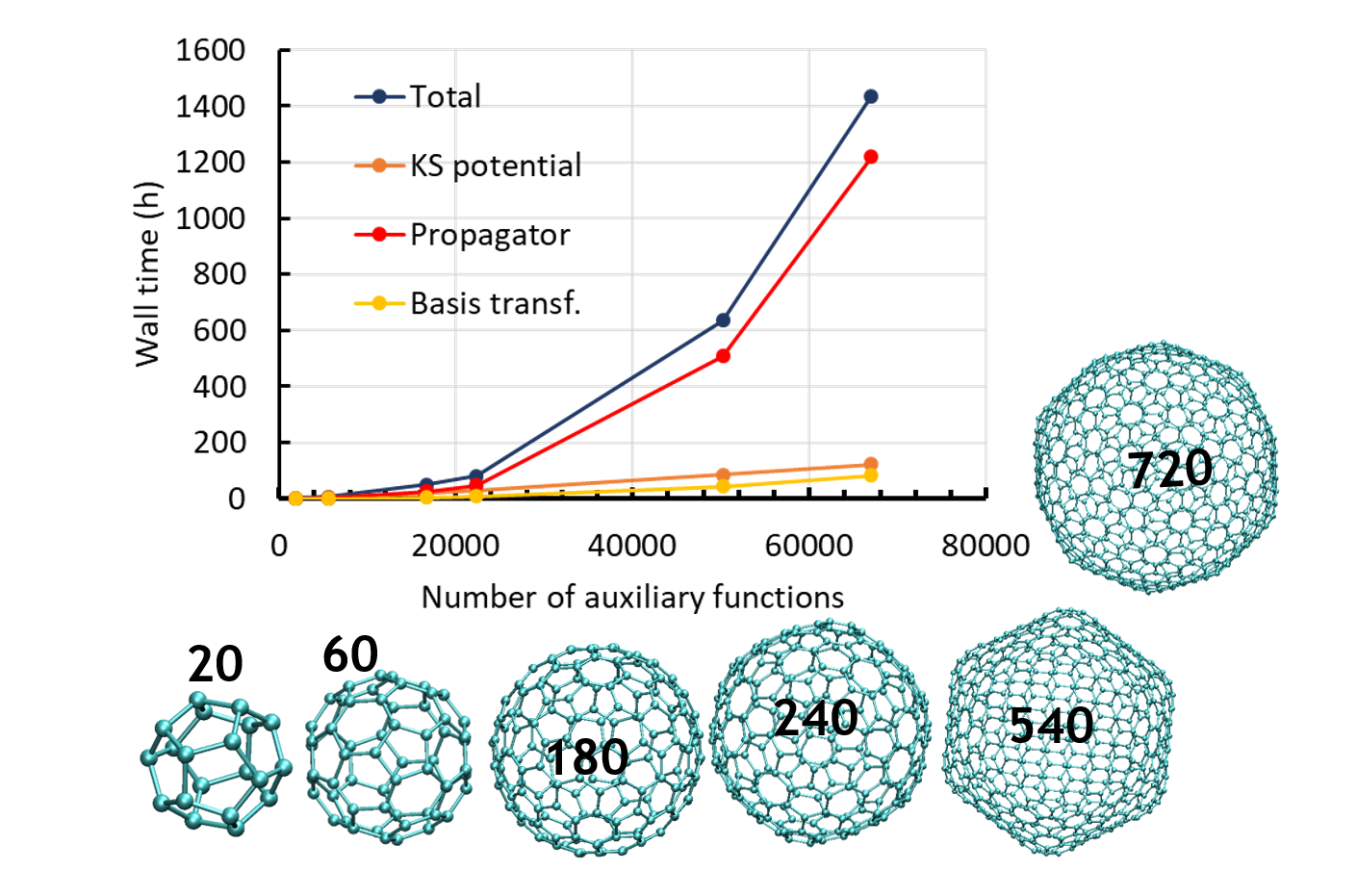
We recently adapted the Auxiliary DFT framework as implemented in deMon2k to the simulation of time-dependent problems via the Runge and Gross equations. Our implementation of the so-called Real-Time-Time-Dependent ADFT (RT-TD-ADFT) fully benefits from the algorithms available in deMon2k to carry out variational density fitting, notably the MINRES algorithm recently proposed for self-consistent-field calculations. We test here MINRES for the first time in the context of RT-TD-ADFT. We report extensive benchmarks calculations to assess the reliability of the ADFT framework. These encompass the construction of absorption spectra in the gas phase and in solvent, the calculation of electronic stopping power curves, the irradiation of zeolites by swift ions and the investigation of charge migrations with attosecond time resolution. All our results are very encouraging. We show that even small auxiliary basis sets are sufficient to obtain results almost undisguisable from those obtained with large and flexible auxiliary bases. Overall, we establish the reliability of RT-TD-ADFT to simulate electronics dynamics in large or very large molecular systems.

Femtosecond responses of hydrated DNA irradiated by ionizing rays focus on the sugar-phosphate part

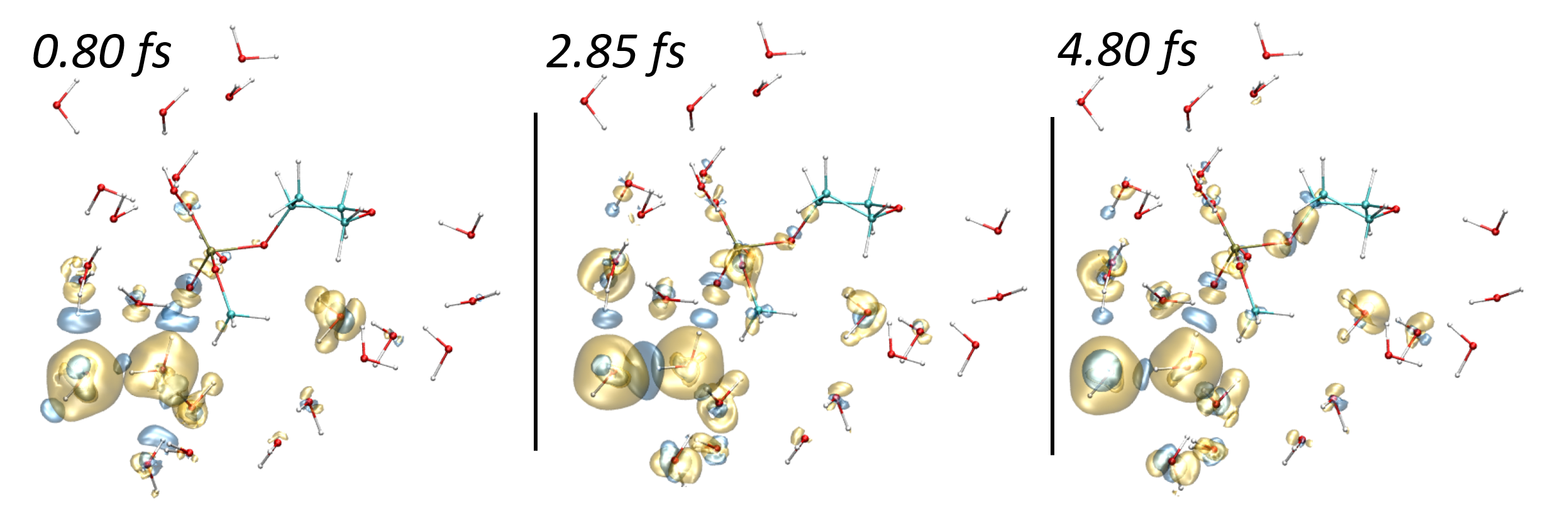
n this article, we investigate the mechanisms of DNA ionization upon irradiation by 0.5 meV alpha particles. We focus on the sugar-phosphate group and its hydration shell. In radiation chemistry, the term quasi-direct effect refers the physical and chemical responses taking place after irradiation of solvent molecules pertaining to the solvation shells of solutes. The molecular mechanisms accounting for the quasi-direct effect are actually largely elusive, especially for those prevailing in the early timescales (< 10–12 s). We report Real-Time Time-Dependent Auxiliary Density Functional Theory simulations carried out within the framework of hybrid QM/MM scheme (Quantum Mechanics/Molecular Mechanics) with polarizable and non-polarizable embedding. Ten water molecules from the solvation shell of DNA backbone are independently irradiated. We find that during the first femtoseconds after irradiation, the holes formed on the irradiated water remain at their sites of formation. Electrostatic induction within the environment does not significantly impact charge migrations. We address the hypothesis that charge migration driven by electron correlation is responsible for an ultrafast H2O+ to DNA charge transfers, which would account for a quasi-direct effect. We find that pure charge migration at fixed nuclear positions is not responsible for the quasi-direct effect when considering sugar-phosphate solvation shells.

The physical stage of radiolysis of solvated DNA by high-energy-transfer particles: insights from new first principles simulations

Aurelio Alvarez-Ibarra, Angela Parise, Karim Hasnaoui, Aurélien de La Lande. Phys. Chem. Chem. Phys. 2020, 22, 7747-7758. doi.org/10.1039/D0CP00165A.

Selected by the editor as a PCCP hot paper.

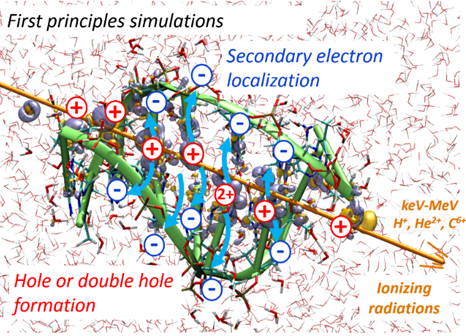
The primary processes that occur following direct irradiation of bio-macromolecules by ionizing radiation determine the multiscale responses that lead to biomolecular lesions. The so-called physical stage loosely describes processes of energy deposition and molecular ionization/excitation but remains largely elusive. We propose a new approach based on first principles density functional theory to simulate energy deposition in large and heterogeneous biomolecules by high-energy-transfer particles. Unlike traditional Monte Carlo approaches, our methodology does not rely on pre-parametrized sets of cross-sections, but captures excitation, ionization and low energy electron emission at the heart of complex biostructures. It furthermore gives access to valuable insights on ultrafast charge and hole dynamics on the femtosecond time scale. With this new tool, we reveal the mechanisms of ionization by swift ions in microscopic DNA models and solvated DNA comprising almost 750 atoms treated at the DFT level of description. We reveal a so-called ebb-and-flow ionization mechanism in which polarization of the irradiated moieties appears as a key feature. We also investigate where secondary electrons produced by irradiation localize on chemical moieties composing DNA. We compare irradiation of solvated DNA by light (H+, and He2+) vs. heavier (C6+) ions, highlighting the much higher probability of double ionization with the latter. Our methodology constitutes a stepping stone towards a greater understanding of the chemical stage and more generally towards the multiscale modelling of radiation damage in biology using first principles.

Multicomponent density functional theory with density fitting

Daniel Mejía-Rodríguez, Aurélien de La Lande, J. Chem. Phys. 2019, 150, 174115, doi.org/10.1063/1.5078596. Full text in HAL

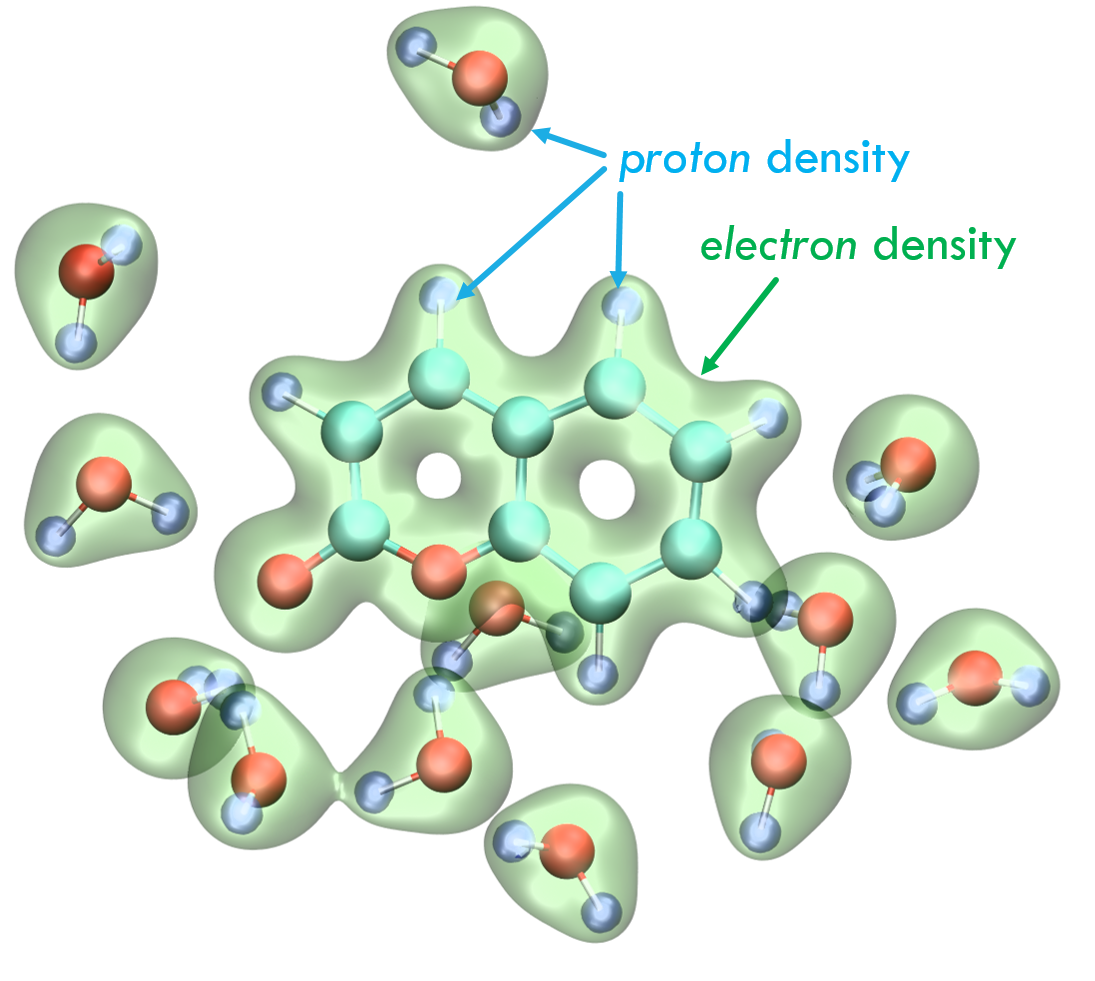
Multicomponent Density Functional Theory (MDFT) is a promising methodology to incorporate nuclear quantum effects, such as zero-point energy or tunneling, or to simulate other types of particles such as muons or positrons using particle densities as basic quantities. As for standard electronic DFT, a still ongoing challenge is to achieve the most efficient implementations. We introduce a multicomponent DFT implementation within the framework of auxiliary DFT, focusing on molecular systems comprising electrons and quantum protons. We introduce a dual variational procedure to determine auxiliary electron and proton densities which leads to a succession of approximate energy expressions. Electronic and protonic fitted densities are employed in (i) electron-electron, proton-proton, and electron-proton classical Coulomb interactions and (ii) electron exchange-correlation, proton-proton exchange, and electron-proton correlation (EPC) potentials. If needed, exact exchange among electrons or among protons is computed by the variational fitting of the corresponding Fock potential. The implementation is carried out in deMon2k. We test various electron proton correlation functionals on proton affinities. We find that auxiliary densities can be safely used in electron-electron, proton-proton, and electron-proton classical Coulomb interactions, as well as in EPC, albeit with some precautions related to the choice of the electronic auxiliary basis set that must be flexible enough. Computational tests reported indicate that introduction of density fitting in MDFT is clearly advantageous in terms of computational effort with good scaling properties with respect to the number of electrons and protons treated at the DFT level.

Molecular simulations with in-deMon2k QM/MM, a tutorial-review

Aurélien de La Lande, Aurelio Alvarez-Ibarra, Karim Hasnaoui, Fabien Cailliez, Xiaojing Wu, Tzonka Mineva, Jérôme Cuny, Patrizia Calaminici, Luis López-Sosa, Gerald Geudtner, Isabelle Navizet, Cristina Garcia Iriepa, Dennis R Salahub, Andreas M Köster. Molecules, 2019, 24, 1653.doi.org/10.3390/molecules24091653. Full text from publisher.

Article from the special issue: Multiscale Chemical Modeling and Simulations Using Quantum Mechanics/Molecular Mechanics (QM/MM))

deMon2k is a readily available program specialized in Density Functional Theory (DFT) simulations within the framework of Auxiliary DFT. This article is intended as a tutorial-review of the capabilities of the program for molecular simulations involving ground and excited electronic states. The program implements an additive QM/MM (quantum mechanics/molecular mechanics) module relying either on non-polarizable or polarizable force fields. QM/MM methodologies available in deMon2k include ground-state geometry optimizations, ground-state Born–Oppenheimer molecular dynamics simulations, Ehrenfest non-adiabatic molecular dynamics simulations, and attosecond electron dynamics. In addition several electric and magnetic properties can be computed with QM/MM. We review the framework implemented in the program, including the most recently implemented options (link atoms, implicit continuum for remote environments, metadynamics, etc.), together with six applicative examples. The applications involve (i) a reactivity study of a cyclic organic molecule in water; (ii) the establishment of free-energy profiles for nucleophilic-substitution reactions by the umbrella sampling method; (iii) the construction of two-dimensional free energy maps by metadynamics simulations; (iv) the simulation of UV-visible absorption spectra of a solvated chromophore molecule; (v) the simulation of a free energy profile for an electron transfer reaction within Marcus theory; and (vi) the simulation of fragmentation of a peptide after collision with a high-energy proton.